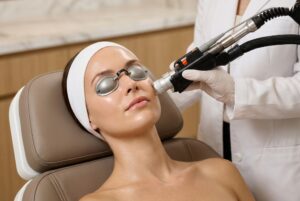
Plan on about 5 to 7 days of social downtime after a standard fractional CO2 treatment at Skin Anthology: redness and swelling for the first three days, then peeling and flaking that usually finishes around day 5 to 7, then pinkness that fades over the following weeks. Deeper treatments can take up to 2 weeks. CoolPeel, the lighter CO2 option, runs 3 to 5 days. This guide walks through each stage, the aftercare that protects your result, the signs worth a phone call, and how to plan a treatment around your calendar.
How long CO2 laser downtime lasts
Downtime depends on how deep the treatment goes, and Skin Anthology offers two depths of the same CO2 technology. Fractional CO2 resurfacing is the deeper single session treatment for sun damage, texture, fine lines and acne scarring. CoolPeel delivers the energy in shorter pulses for surface refinement, usually as a series. The recovery windows below are the ones on the CO2 laser page and the CoolPeel page.
| Treatment | What happens when | Plan for |
|---|---|---|
| Fractional CO2 Single deeper session | Redness and swelling, days 1 to 3 Peeling and flaking, days 4 to 7 | 5 to 7 days; up to 2 weeks if deeper |
| CoolPeel Series of 3 to 6 | Redness and swelling, days 1 to 3 Rough or flaky skin, days 3 to 10 | 3 to 5 days of visible redness |
Timelines from the Skin Anthology CO2 laser and CoolPeel service pages. Individual healing varies, and residual pinkness can last longer for some people.
Independent guidance lines up. The Mayo Clinic reports that after ablative laser resurfacing, new skin usually covers the treated area in 7 to 10 days and full recovery takes at least a month. Visible downtime and full healing run on two different clocks.
Fractional lasers leave islands of untouched skin on purpose.
A fractional CO2 laser treats the skin in microscopic columns rather than removing the whole surface. The Mayo Clinic explains that fractional lasers shorten recovery time and reduce the risk of side effects, and that they have become the widely preferred method. The healthy skin between the columns is what lets the face repair itself in days rather than weeks.
CO2 laser recovery day by day
Days 1 to 3. Redness, swelling and warmth are expected, and the skin feels tight and sensitive, much like a strong sunburn. The Mayo Clinic notes that a pain reliever and ice packs can help. Your provider applies a thick healing ointment before you leave and tells you how to keep the skin coated at home.
Days 4 to 7. Peeling, flaking and light crusting take over as new skin forms underneath. Pinkness is common. The Skin Anthology aftercare guidance is firm here: no picking, no scrubbing, no exfoliating. Let the skin shed on its own schedule.
Weeks 2 to 4. The new skin strengthens and redness fades to a light flush that may still show after heat or exercise. Makeup can be reintroduced once your provider has cleared it.
Months 1 to 6. Visible downtime is over, but collagen remodeling continues beneath the surface, supporting smoother texture, more even tone and firmer looking skin. Results keep improving well after the peeling has stopped.
Aftercare that protects the result
In the first days, the job is to keep the new skin covered and calm. Use only the gentle cleanser and moisturizer your provider recommends, keep the healing ointment on as directed, and stay out of the sun. The Mayo Clinic advises against cosmetics or anything that could irritate the face while it heals, and against infection risks such as public whirlpools.
Heat is the other thing to avoid early on. Skin Anthology asks patients to skip strenuous exercise, saunas, hot tubs, alcohol and anything that rubs the treated skin, because all of them increase swelling and irritation. Retinoids, exfoliating acids and other actives stay paused until your provider clears them.
Once the surface has closed, sun protection becomes the long term rule. The Mayo Clinic recommends a moisturizer and a sunscreen of SPF 30 or higher every day after laser resurfacing, and notes that tinted sunscreens with iron oxide and titanium dioxide are especially useful for brown or Black skin. The American Academy of Dermatology puts it plainly: without daily sun protection you risk side effects from treatment and may not get the results you paid for.
The most common infection after resurfacing is a cold sore flare.
The Mayo Clinic lists bacterial, viral and fungal infection among the risks of laser resurfacing, and names a flare up of the herpes virus, the one that causes cold sores, as the most common. That is why the Skin Anthology consultation asks about your cold sore history, and why you may be prescribed an antiviral medicine to take before and after treatment as a precaution.
When to call the clinic
Redness, swelling, itching, oozing and flaking all belong to normal healing. What does not belong is a change in direction: symptoms that were improving and then get worse. Call Skin Anthology at (310) 482-2081 if you notice any of the following.
- Increasing pain, spreading redness, warmth or pus, especially with a fever. These point toward infection rather than routine healing.
- Clusters of small blisters or unusually painful sores, which can signal a cold sore flare that needs antiviral treatment started quickly.
- Peeling or crusting that continues well past the two week mark, since slow healing is easier to manage early.
- Patches turning noticeably darker or lighter in the weeks after healing. The Mayo Clinic notes that both darkening and loss of colour can follow laser resurfacing, and that early attention helps.
None of these mean something has gone wrong for certain. They mean a provider should look.
Why downtime differs from person to person
Treatment depth. Depth and coverage are adjustable, and the deeper the pass, the longer the peel. Settings are chosen at the consultation against your skin, your goals and the recovery time you can give it.
Skin tone. The Mayo Clinic notes that people with brown or Black skin have a higher risk of long term colour changes after laser resurfacing, and recommends choosing a provider experienced in selecting lasers and settings for a range of skin tones. If you already manage sun spots or melasma, pigmentation correction may be part of the same conversation.
Medical history and habits. The Mayo Clinic cautions against laser resurfacing for people who have taken isotretinoin in the past year, who have a history of keloid scars or a weakened immune system, or who are pregnant or breastfeeding, and it advises smokers not to smoke for two weeks before and after treatment. Skin Anthology asks about all of these before booking.
Sun exposure before your appointment can change the outcome after it.
The Mayo Clinic warns that too much sun in the two months before laser resurfacing can cause a permanent change in skin colour in the treated area. Skin Anthology asks patients to avoid tanning, sunburn and prolonged sun exposure for at least 2 to 4 weeks before a CO2 treatment, and recently sun exposed skin may not be eligible on the day.
Planning a CO2 treatment around your calendar
The appointment takes 45 to 90 minutes depending on the area. The planning question is what comes after it. If you have a wedding, a shoot or a big meeting inside the next two weeks, say so at the consultation. A standard fractional CO2 session wants a clear 5 to 7 day window away from work, social events and the sun, and a deeper one up to 2 weeks. CoolPeel, with 3 to 5 days of visible redness, fits a tighter calendar and builds its result over 3 to 6 treatments about 4 to 6 weeks apart.
| Treatment on the current price list | Area | Price |
|---|---|---|
| Fractional CO2 | Full face | $999 |
| Fractional CO2 | Full face and neck | $1,399 |
| Fractional CO2 | Neck and décolleté | $1,399 |
| Fractional CO2 | Full face, neck and décolleté | $1,699 |
| CoolPeel | Full face | $799 (package of 3: $2,037.45) |
| CoolPeel | Full face and neck | $1,119 (package of 3: $2,853.45) |
Prices are from the current Skin Anthology price list, where CoolPeel packages of three are 15 percent off. Combination specials that pair CO2 or CoolPeel with XERF are listed there too.
CO2 resurfacing is not limited to the face. Our guide to CO2 laser resurfacing for stretch marks covers the same technology on the body. For a laser treatment at the other end of the downtime scale, our laser hair removal cost guide describes skin that is flushed for a few hours rather than days, and what you need to know about laser hair removal covers the appointment itself.
Frequently asked questions
How long is CO2 laser downtime?
Is CoolPeel downtime shorter than a full CO2 treatment?
When can I wear makeup again after CO2 laser resurfacing?
Does CO2 laser resurfacing hurt?
How much does CO2 laser resurfacing cost at Skin Anthology?
How many CO2 laser sessions will I need?
Get a downtime plan built around your calendar.
The consultation is free. Your skin is assessed in person, the depth is matched to the time you can give it, and you leave with a written pre and post treatment plan. Skin Anthology Med Spa, 848 N La Cienega Blvd, West Hollywood.
Prefer to talk? (310) 482-2081
Sources: Mayo Clinic, Laser resurfacing; American Academy of Dermatology, How dermatologists treat sun damaged skin; Skin Anthology CO2 laser and CoolPeel service pages and price list. This article is general information, not medical advice; suitability is assessed at your consultation.