PRP hair restoration can help thinning hair, but it is a gradual treatment, not a quick fix. The American Academy of Dermatology says studies show platelet rich plasma can be a safe and effective hair loss treatment, while the Cleveland Clinic notes that results vary and the research is still early. This guide covers how PRP and PRF work, what the evidence says, what a session at Skin Anthology involves, and how hair restoration with PRF is planned and priced.
What PRP and PRF are
Both treatments start with a small sample of your own blood. According to the Cleveland Clinic, platelet rich plasma (PRP) is made by spinning the blood in a centrifuge, which separates it by weight and concentrates the platelets in the plasma. Platelets carry proteins called growth factors, and those are what the treatment relies on.
Platelet rich fibrin (PRF) is a close relative. Skin Anthology prepares PRF by processing the blood at a low speed so it keeps platelets, fibrin, white blood cells and growth factors together. The fibrin forms a matrix that releases growth factors gradually rather than all at once, so the signaling in the scalp lasts longer.
PRF is what Skin Anthology uses for hair restoration. The same idea of working with your own blood appears elsewhere on the menu: Selphyller PRFM plasma gel for the face, and PRF as a microneedling enhancement.
A PRP injection is far richer in platelets than ordinary blood.
The Cleveland Clinic explains that a PRP injection has five to 10 times as many platelets as a normal blood sample. Because it is made from your own blood, it also avoids the complications that come with donor blood.
What the evidence says
The American Academy of Dermatology lists PRP among the procedures that can help regrow hair and says studies show it can be a safe and effective hair loss treatment. It describes a schedule of one visit a month for 3 months, then one every 3 to 6 months, and says that within the first few months you may notice you are losing less hair.
The Cleveland Clinic is more cautious. It says research on PRP is still at a relatively early stage and the results are mixed, partly because there is no single standardized way to prepare it, so the density of platelets can differ from one product to the next. Some people benefit and others do not, and providers cannot predict with certainty who will.
Two more points are worth knowing:
- It is usually part of a plan. The Cleveland Clinic says providers generally offer PRP as an adjunct therapy, a helpful addition rather than the only treatment.
- Pairing can help. The AAD notes studies showing that microneedling combined with another treatment, including platelet rich plasma, helps improve hair growth.
Start with the cause of your hair loss
The AAD is clear that effective treatment for hair loss begins with finding the cause. Diagnosis usually involves questions about how long the hair loss has been happening and whether it came on quickly, a close look at the scalp and nails, and sometimes a gentle hair pull test.
If a disease, vitamin deficiency, hormone imbalance or infection could be behind it, the AAD says a blood test or scalp biopsy may be needed.
The AAD also notes that some hairstyles and hair care habits can damage hair, and changing them can help. Bring your history to your consultation, including when the thinning started, any recent illness, and treatments you have already tried.
Sometimes hair grows back on its own.
The American Academy of Dermatology says hair may regrow without treatment after you recover from a major illness or surgery, or with a mild case of alopecia areata. In other cases treatment helps it grow back more quickly, or is needed to prevent further loss.
What a PRF session at Skin Anthology involves
Share every medication, supplement and medical condition, since some affect bleeding or healing, but do not stop a prescription medicine unless your prescribing clinician advises it. Mention any scalp irritation, infection, recent procedures or tender areas.
Arrive well hydrated and eat a light meal beforehand to lower the chance of feeling lightheaded. Wash your hair the day of or the day before, and skip styling products, dry shampoo and topical scalp treatments before the appointment.
The appointment takes about 45 to 60 minutes. A small blood sample is drawn and processed on site, then the PRF is injected into the thinning areas of the scalp with fine needles. Most patients feel pressure and brief stinging; comfort measures are used as appropriate and the pace is kept controlled.
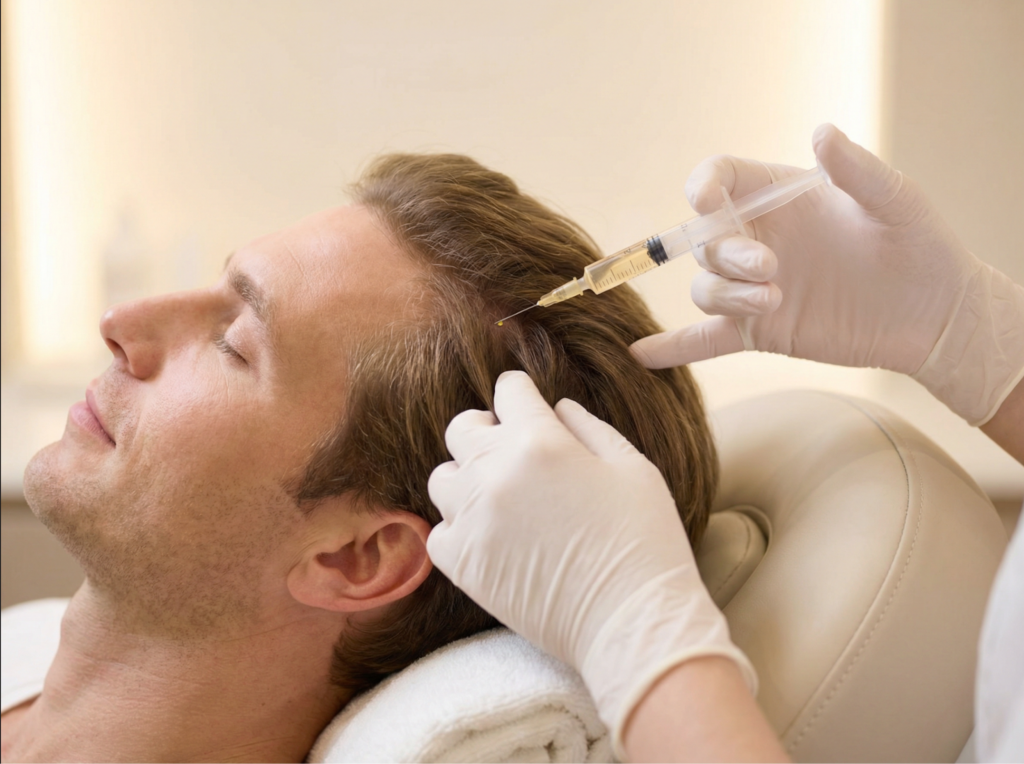
Afterwards, mild tenderness, swelling or scalp sensitivity may occur and typically resolves within a few days. For 24 hours, avoid vigorous exercise, heat and handling your scalp. Gentle hair washing can usually resume the next day unless your provider says otherwise.
The injections are the quick part.
The AAD says the PRP procedure itself takes about 10 minutes and usually needs no downtime. Most of a Skin Anthology appointment goes to drawing your blood and preparing the PRF on site before the injections begin.
Sessions, results and cost
Hair restoration is a series, not a single visit. Here is how the AAD’s typical PRP schedule compares with the Skin Anthology PRF plan:
| Plan | PRP | PRF |
|---|---|---|
| Series | 3 visits | 3 to 6 |
| Spacing | Monthly | 4 to 6 weeks |
| Upkeep | 3 to 6 months | As needed |
PRP: the AAD’s typical schedule. PRF: the Skin Anthology plan, with maintenance set by your response and goals.
Expect results to build slowly. Shedding may look the same at first, and improvements in thickness, quality and density typically develop over several months. Results vary with your pattern of hair loss and how your follicles respond.
Hair restoration with PRF does not carry a fixed price on the current price list. It is priced by the treatment area and the number of sessions recommended for you, with package pricing for a planned series, and the plan and price are reviewed at your consultation. The Cleveland Clinic notes that PRP is relatively expensive because it cannot be mass produced, so weigh the cost of the whole series, not one visit.
The hair restoration page lists microneedling and red light therapy among its related treatments. If you are weighing them, the guides to microneedling and scarring risk and red light therapy safety explain what each involves.
Who should ask first
The Cleveland Clinic says PRP injections have very few risks: a remote chance of contamination if the blood is not kept sterile during preparation, and the possibility of more discomfort than you expect. Some swelling and pain at first is normal and may last a day or two.
It also notes that people with certain blood conditions may not be good candidates, and your provider might ask you to stop certain medications first. That is why the health review comes before any blood is drawn, and why active scalp irritation or infection means waiting.

Frequently asked questions
Does PRP really regrow hair?
How many hair restoration sessions will I need?
When will I see results?
Does PRF hair restoration hurt?
How much does PRF hair restoration cost?
Find out if PRF hair restoration suits you.
The consultation is free. Your provider reviews your health history and your scalp, and you leave knowing the session plan and the price before you commit. Skin Anthology Med Spa, 848 N La Cienega Blvd, Los Angeles.
Prefer to talk? (310) 482-2081
Sources: American Academy of Dermatology, Hair loss: Diagnosis and treatment; Cleveland Clinic, Platelet Rich Plasma (PRP Injection); Skin Anthology hair restoration, Selphyller and consultation pages and price list. This article is general information, not medical advice.