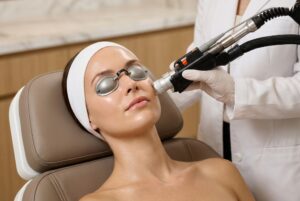
Yes, a laser can fade most sun spots and brown spots. At Skin Anthology, laser pigmentation correction starts at $249 a session for the full face, and most patients plan for 3 to 6 sessions about 4 to 6 weeks apart. This guide covers which spots respond, which ones a doctor should see first, what a session feels like, what it costs and how to keep new spots from forming.
What a laser does to a dark spot
Most of the dark spots people want gone are age spots. The Mayo Clinic describes them as small, flat dark areas that usually appear on skin exposed to the sun, such as the face, hands, shoulders and arms, and notes they are also called sunspots, liver spots and solar lentigines. They form when ultraviolet light speeds up melanin production and the pigment clumps or builds up in high concentrations.
A pigment laser works on that concentrated melanin. On the Skin Anthology laser pigmentation and brown spot correction page, the treatment is described as calibrated pulses of light drawn to areas of pigment. The energy breaks the pigment into smaller particles while the surrounding skin is preserved, and the body then clears the treated pigment over the following weeks.
That is why results are gradual. A treated spot does not vanish on the table. It usually darkens first, then flakes or fades as the skin renews, and tone keeps refining as a series of sessions builds.

Freckles fade in winter. Age spots do not.
The Mayo Clinic points out that freckles are common in children and fade without sun exposure, while age spots stay put. Age spots can also grow and group together over time, giving the skin a speckled or mottled look, which is why many people treat the full face rather than one spot at a time.
Which dark spots respond best
Sun spots and brown spots. The Mayo Clinic describes age spots as flat, oval, tan to dark brown, and anywhere from freckle size to about half an inch across. These are the spots the Skin Anthology pigmentation treatment is built for, along with the uneven tone that comes with years of sun.
Melasma and past pigment treatments. If you have melasma, or have treated pigment before, say so at the consultation. Skin Anthology asks about melasma history, prior pigment treatments, medications and recent procedures before a session so the settings can be chosen for your skin.
Red spots and visible vessels. Redness is not pigment, and it is treated differently. Laser vascular therapy targets the vessels behind persistent redness and visible capillaries, and is priced separately on the price list.
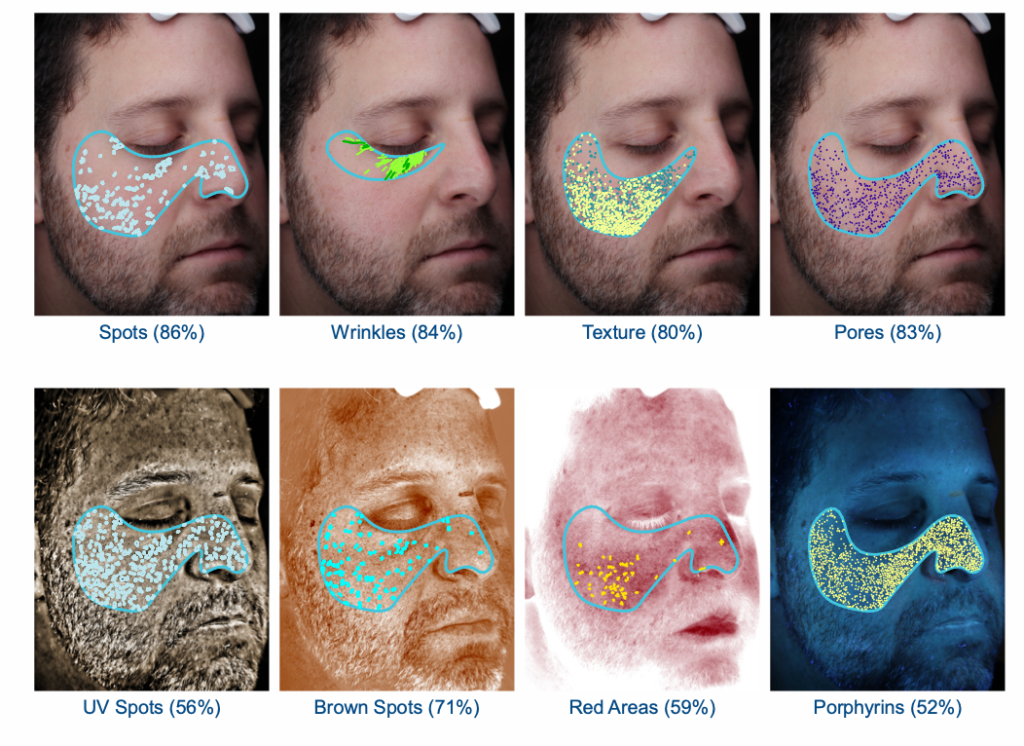
Not sure which you have? Skin Anthology consultations are free, and when it helps, VISIA facial analysis is included at no extra cost. The imaging maps pigmentation patterns and UV related changes that are not always visible in a mirror.
When a spot needs a doctor first
True age spots are harmless and do not need treatment. The problem is that, as the Mayo Clinic notes, age spots can look like cancerous growths. A biopsy can tell an age spot apart from lentigo maligna, a type of skin cancer, and cosmetic laser is not the place to find out which one you have.
The American Academy of Dermatology uses the ABCDEs of melanoma to describe the spots worth a closer look:
- Asymmetry: one half of the spot is unlike the other half.
- Border: the edge is irregular, scalloped or poorly defined.
- Colour: shades vary across the spot, such as tan, brown or black, or areas of white, red or blue.
- Diameter: melanomas are usually larger than 6 millimetres, about the size of a pencil eraser, though they can be smaller.
- Evolving: the spot looks different from the rest or is changing in size, shape or colour.
If a spot is new, different from your others, or changing, itching or bleeding, the AAD advises seeing a board certified dermatologist before anything else. Laser pigmentation correction is also not recommended during pregnancy or while breastfeeding, and skin that is freshly tanned should wait until it is back to its natural tone.
Tanning beds cause age spots too.
The Mayo Clinic lists commercial tanning lamps and beds as a cause of age spots, alongside years of sun exposure. A history of frequent or intense sun or sunburn raises the odds of developing them, and while age spots are very common after 50, younger people who spend time in the sun get them as well.
What a laser pigmentation session is like
Before. Avoid tanning, spray tans and prolonged sun for at least 1 to 2 weeks. Hold retinoids, exfoliating acids and other strong actives on the area for 3 to 5 days unless your provider says otherwise, and arrive without makeup, lotion or sunscreen on the treatment area. Do not stop any prescribed medication unless the clinician who prescribed it advises you to.
During. A session takes 15 to 45 minutes depending on the size and number of areas. Settings are selected for your skin type and pigment depth and adjusted as the provider watches how the skin responds. Most people describe brief warmth or a light snapping feeling. Integrated cooling runs throughout, and the service page notes the treatment is generally well tolerated without numbing.
After. Mild redness or warmth is common and often settles within hours. Treated spots may darken, flake or fade as the skin renews, and that temporary darkening is part of the process, not a sign it failed. For 24 to 48 hours, skip hot baths, saunas, intense exercise and direct sun, and use gentle skincare only until the skin has settled.
How many sessions and what it costs
Most patients benefit from 3 to 6 sessions spaced about 4 to 6 weeks apart. The count depends on the type, depth and spread of the pigment, which is why it is set at the consultation rather than quoted up front. The Mayo Clinic notes that laser and intense pulsed light approaches to age spots typically take two to three sessions, so a few scattered spots can need fewer visits than full face uneven tone.
| Area | Per session | Package of 3 |
|---|---|---|
| Full face | $249 | $634.95 |
| Neck and décolleté | $249 | $634.95 |
| Face, neck and décolleté | $449 | $1,144.95 |
| Arms | $249 | $634.95 |
| Back | $299 | $762.45 |
| Legs | $299 | $762.45 |
Prices from the current Skin Anthology price list. Package prices are the three session total at 15 percent off.
Three full face sessions paid one at a time come to $747. As a package, the same three sessions are $634.95. Because the Mayo Clinic notes that age spot treatments are considered cosmetic, they typically are not covered by insurance, so it helps to plan the whole series before the first visit.

Sunscreen is part of the treatment, not an extra.
After age spot treatment, the Mayo Clinic advises a broad spectrum sunscreen of at least SPF 30 and protective clothing whenever you are outdoors. It recommends applying sunscreen 15 to 30 minutes before going out, reapplying every two hours, and avoiding the sun between 10 a.m. and 2 p.m. when its rays are strongest.
Keeping new spots from forming
A laser clears the pigment that is there. It does not stop the sun from making more. Skin Anthology calls daily broad spectrum sunscreen essential to protect results and reduce the risk of new pigmentation, and the Mayo Clinic gives the same advice for preventing new spots after treatment.
- Sunscreen every day, SPF 30 or higher, reapplied every two hours outdoors and more often if you swim or sweat.
- Cover up: a broad brimmed hat protects more than a baseball cap, and the Mayo Clinic suggests clothing labelled UPF 40 to 50.
- Time outdoor plans outside the 10 a.m. to 2 p.m. window when you can.
- Book touch ups as your provider recommends, since the pigmentation treatment pairs easily with facials, resurfacing and other skin quality treatments.
If texture and fine lines bother you as much as colour, deeper resurfacing may come up at the consultation. The CO2 laser downtime guide explains what that recovery looks like day by day. For the same kind of price breakdown on another laser, see the laser hair removal cost guide, and laser hair removal for the face covers another laser treatment done on the same skin.
Frequently asked questions
Can a laser remove dark spots?
How many laser sessions do dark spots need?
How much does laser dark spot removal cost at Skin Anthology?
Does laser pigmentation treatment hurt?
Is there downtime after laser for dark spots?
Should a doctor check a dark spot before laser treatment?
Find out what your dark spots need.
The consultation is free. Your spots are assessed in person, anything that needs a doctor is flagged first, and you leave knowing the session count and the price before you commit. Skin Anthology Med Spa, 848 N La Cienega Blvd, West Hollywood.
Prefer to talk? (310) 482-2081
Sources: Mayo Clinic, Age spots (liver spots); American Academy of Dermatology, ABCDEs of melanoma; Skin Anthology laser pigmentation, laser vascular therapy, VISIA and consultation pages and price list. This article is general information, not medical advice; suitability is assessed at your consultation.